In Double Oak, types of escaped animals can prompt a double take

Uncategorized
By ADAM SCHRADER
Published in The Dallas Morning News on Dec. 4, 2015

It’s common for livestock to escape in Double Oak, a town just west of Flower Mound that is often considered an urban farming community because of its large acreage properties.

But regardless of its regularity, escaped livestock still excites those who spot the missing mammal.

“There has been a longhorn going through the yards on South Forest Lane for the last couple of hours,” a Double Oak resident posted on Facebook this morning. “I tried to go over there to let them know but they have an electric gate. Only in Texas lol!”

Blake Ringberg, a Double Oaks police officer, said that by the time he responded to the call, the owner already had the longhorn put up.

Residents in the 200 block of Kings Road have three longhorns “that are basically pets of theirs,” Rinbgberg said. A creek on the backside of their property touches the fence line. Because of heavy rain last week, part of the fence washed way.

The owner was able to get the animal corralled and was repairing his fence.

About a third of the residents in Double Oak have some sort of livestock. You’re not quite sure what you’re going to see from day to day.

Ringberg said he’s seen everything from horses and longhorns to miniature donkeys and llamas. At one time, a zebra even called Double Oak home.

“You wouldn’t think you’d get livestock calls in a metropolitan area, but we do frequently and actually keep equipment in the car to wrangle them,” Ringberg said. “We keep horse halters, horse ropes, lead ropes, snake poles, pretty much anything for an animal we’d need to deal with.”

Review: Musical Theater of Denton’s ‘The Addams Family’ — a show to die for

Uncategorized
By ADAM SCHRADER
Published in The Dallas Morning News on Oct. 30, 2015

It was a dark and stormy night – the perfect setting for the Musical Theater of Denton’s performance of The Addams Family.

(Ironically, I almost died twice in the torrential monsoon on the way up from Dallas to see the show.)

I walked in to the Campus Theater off the square through a side door to witness the lobby, decorated spooktacularly as the inside of the Addams home.

But it wasn’t a somber event. The laughs of the lively audience started before the show even began.

“Remember: if you have small children with you, make sure to eat them,” the announcer said as the houselights dimmed.

The Addams Family musical seems to pick up years after the movies left off — filling the void we’ve all craved since the unfortunate Addams Family Reunion.

Morticia and Gomez want to continue living the way they always have. But Wednesday has fallen in love with a “normal” boy from Ohio, Lucas Beineke.  The Addams invite the Beinekes to their home for dinner. Secrets are kept and strain is put onto the family that relishes in pain and suffering.

It’s said the musical follows the characterizations of the animated TV show. But, the makeup, costumes and set design were stylized perfectly after the 1991 movie. In fact, the entire production mirrored the early ’90s films.

Alexis Romero, who portrayed Gomez, delivered each punch line of his dad-like one-liners and each song of his devotion to his wife Morticia, played by Anjelica Houston’s younger doppelganger Liz J Millea, in the style of Raul Julia down to the accent. Millea also gesturized like her predecessor in the role.

Paul Iwanicki played Uncle Fester with the mischievousness of Christopher Loyd, and taught us to love how only Fester can. Kristen Brasher played Grandma Addams, “who may or may not be in the family”. Her hilarious portrayal left me crying from laughter by intermission.

Jason Joos, who played Mal Beineke, made for a potent antagonist — but could have annunciated more as he was often unintelligible. Kristi Smith Johnson, who played Alice Beineke, Lucas’ mother, was surprisingly funny and showed some of the greatest character depth onstage.

The dynamic between Cameron Dinger (Pugsley) and Meagan Black (Wednesday) was perfect and I wish there were more scenes with just the two of them; but the chemistry between Black and Jacob Lewis, who played her love interest Lucas, was lacking.

Lewis had a brilliant improvised line that received thunderous laughter when Black accidentally calls him by his real name, yelling “It’s Lucas!”

However, most of the time Lewis was difficult to hear as his microphone seemed to be turned down.

Overall, it was a true ensemble cast — no actor outshining another. Though at times, even Lurch stole the show without saying a word.

Directors Bill Kirkley and Choreographer Rebecca McDonald made sure the entire stage was used effectively. Some of my favorite scenes, like Wednesday’s loving torture of Pugsley, were conducted on the sides of the stage.

There was not an opportunity missed, except maybe long drop for a mischievous boy from the second story of Addams mansion. The writers even made pointed social commentary in the liberal persuasion.

Of course, no Addams Family production is complete without a killer Dancing with the Stars-esque tango between a loving husband and wife.

Standing ovation after a killer dance and intoxicating musical numbers in second act left everyone snapping and humming out of theater.

The show has some language and sexual references and is inappropriate for children; but, it teaches the values of family and love. Cherish your families, folks.

Flower Mound approves stricter sex offender ordinance as safety measure

Uncategorized
By ADAM SCHRADER
Published in The Dallas Morning News on Nov. 6, 2015

Sex offenders have fewer options to reside in Flower Mound after changes were made to the town’s ordinance.

The changes collapsed pockets where offenders could live in eastern Flower Mound and created areas where they cannot live in the western part of town, which was previously open to them. The town unanimously approved the ordinance 5-0 at its Sept. 21 meeting.

Now, registered offenders must remain 2,000 feet from locations where children commonly gather. That distance was previously 1,500 feet. The changes also added trail systems and public or private youth centers to the previous list of prohibited areas of public parks, public and private schools, public and semi-public swimming pools, day care centers and video arcades.

“The first priority of any PTA is the safety and well-being of our children,” said Katherine Sells, president of the Lewisville Council of PTAs. “We support any ordinance or law that increases the safety of our children, whether that’s on the bus, on school grounds or at home.”

Deputy Mayor Pro Tem Itamar Gelbman championed the ordinance, hoping to keep Flower Mound one of the safest towns in the country, he said.

“I don’t see this as a second punishment for the sex offenders, I see it as a safety measure,” he said. “We have not banned them from Flower Mound, they can still live in the town — we just made it safer for the kids.”

The lives of sex offenders

All 18 registered sex offenders in Flower Mound will be grandfathered in under the old ordinance for their existing addresses, according to Flower Mound Police Capt. Wess Griffin. New or repeat offenders who already own or rent homes in town are also filed under the old ordinance.

Griffin supplied neighborsgo with a new map of the prohibited areas. Two offenders live outside the restricted areas, both in the western part of Flower Mound which is mostly undeveloped or with expensive estates that can be difficult to afford for sex offenders.

Gelbman said the town still has room for them to move in — even if not immediately. Much of western Flower Mound is under development into low- and medium-density residential neighborhoods. A large portion is zoned for agricultural use. Most of this land also lies in the Cross Timbers Conservation Development District where development and re-zoning are limited but still possible.

“The western part of Flower Mound is a little bit more expensive than the eastern part,” he said. “It’s harder for them to live there because market conditions dictate that the western part of Flower Mound is more expensive. There’s nothing I can do about it.”

Town council member Bryan Webb lives in the western part of town. He said he’s not concerned that the area will become a “sex offender haven.”

The land will develop along the same lines as Chimney Rock or High Meadow, “with 1- or 2-acre lots at a significant price point,” he said, but “it wasn’t intentional to block out the entire town.”

“There is a school being built at Canyon Falls. There is land being purchased for parks,” he said. “And in terms of the large landowners, I’d be surprised if they would be interested in cutting off a 2-acre plot for an individual house.”

The ordinance does not consider landscaped street medians as public parks or equestrian trails as multi-use trails, which is what makes west Flower Mound an option for sex offenders.

Although the Flower Mound ordinance might seem strict, it’s lighter than many area restrictions.

Richardson’s ordinance, passed in October 2006, also makes the buffer zone 2,000 feet, which causes 98 percent of the city to be off-limits to convicted child molesters.

Aubrey City Council passed a sex offender ordinance on July 21. The city made it unlawful for sex offenders to live within 1,000 feet of where children gather, and also made it illegal to loiter within 300 feet of a child safety zone. Violators can be fined $2,000 a day for each violation. In Flower Mound, violators are charged with a misdemeanor and upon conviction fined a sum not to exceed $500 for each offense.

Little Elm passed an ordinance in 2007 that also established a 1,000-foot buffer zone. It furthered restrictions by prohibiting sex offenders from visiting within that zone. It provides exemptions so offenders can attend school, transport their minor children to and from school, engage in business or visit friends and family. However, law enforcement might require proof.

Facing lawsuits

Lewisville restricts sex offenders from living within 1,500 feet of schools, playgrounds, day-care centers and pools. In 2012, The Dallas Morning News reported that Aurelio Duarte and his family sued the city in federal court for its restrictions after two years of living in a 780-square-foot room in an extended-stay motel. The city passed its sex-offender ordinance while Duarte was in jail.

The lawsuit failed and was appealed multiple times. On Aug. 21, a U.S. magistrate for the federal Eastern District of Texas in Sherman recommended to the U.S. District Court that the Duarte claims be dismissed.

In March, the Denton Record-Chronicle reported that Krum was hit with a lawsuit alleging its 2,000 feet restrictions are unconstitutional after a resident was ordered to leave his parents’ house. The lawsuit cites a March 2007 ruling from then-Attorney General Greg Abbott that general-law towns such as Krum cannot enact sex-offender residency restriction ordinances under the Texas Constitution unless authorized by the Legislature.

When the Flower Mound ordinance was before Town Council, Webb inquired about the status of the Lewisville litigation.

“It is a concern of mine,” he said. “My request to the town attorney when we passed the changes was that they monitor that Lewisville litigation closely and advise us of any changes very quickly.”

Gelbman said he is not concerned about the lawsuits and feels “very comfortable that the ordinance will sustain in court and be enforceable.”

508 Park Fiddle Contest picks up long tradition

Uncategorized
By ADAM SCHRADER
Published in The Dallas Morning News on Nov. 8, 2015

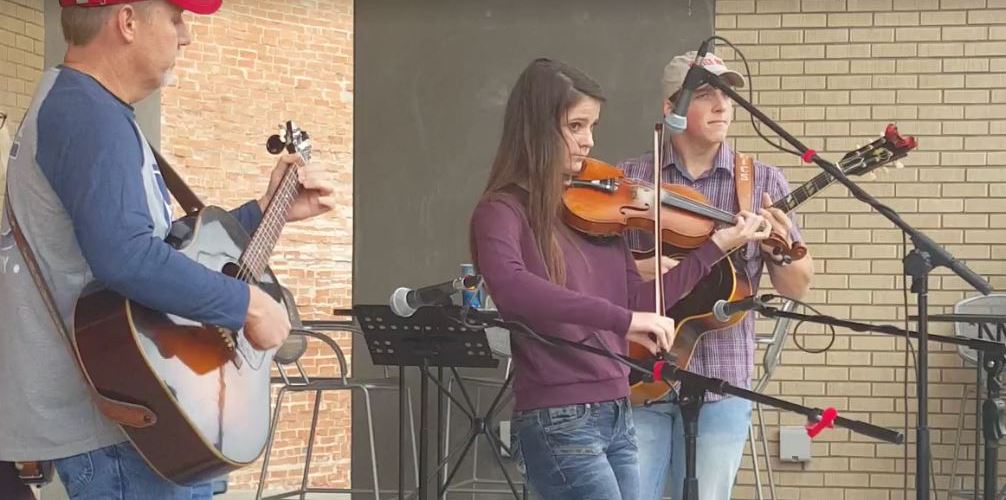
More than 30 musicians competed Saturday in the first 508 Park Fiddle Contest and Concert Series.

“I can’t even guess how much money is here right now, from the old Gibson guitars of the accompanists to the fiddles themselves,” said Ed Carnes, a board member of The Texas Old Time Fiddlers Association.

TOTFA helped organize the first Dallas fiddle contest in 50 years. Bluegrass Heritage Foundation founder and president Alan Tompkins was master of ceremonies for the first of a music series put on by the Museum of Street Culture.

Carnes, who placed second in the Adult Fiddle category for ages 40 to 64, hoped the event would preserve the art of Texas fiddling.

“More than 20 years ago, there were at least 50 fiddling contests in the state and people were passionate about it,” he said. “They grew up listening to that music. When those people aged and couldn’t play anymore or passed along, some of the contests stopped happening.”

So, this competition tried to attract a younger crowd with $4,000 in cash prizes.

Brayden Baird, 8, was the only contestant in the Small Fry category for ages 8 and younger.

“I’ve been playing for a year,” he said, proudly pointing out that his favorite radio station is Bluegrass Junction. “I don’t get nervous. It’s my third time performing in a contest. I just pretend it’s me and the guitar.”

He begged for a jacket, though, the second he got offstage. The cold was the only thing that did bother him, and he wasn’t the only one.

Christianna Nugent, 12, received first in the Junior-Junior Division for ages 9 through 12. She played 49 Hats in a Rain Barrel and Lovers’ Waltz.

“I hit a few bad notes today,” she said. “If it’s too hot, my hands get sweaty and it’s hard to hit the notes. If it’s cold, my fingers get cold and it’s hard to move them.”

Her sister, Noelle Nugent, received second place in the Junior Division for ages 13 to 17. Her sisters Karissa and Faith placed third and fourth respectively in the Young Adult fiddle category, for ages 18 to 39.

Christianna said she’s happy to win, but it’s really about family and not just her biological one.

“My sisters have been in this a long time, so we’ve been to many competitions and it has definitely become like family for us here with all our friends,” she said.

Organizers introduced a category called the Roots of Western Swing to pay homage to the playing styles of Bob Wills and The Texas Playboys, The Light Crust Doughboys, Roy Newman and others who recorded at the 508 Park building. Music executive Don Law produced 843 recordings, including ones from those groups, between 1935 and 1939.

“Normally, in a fiddle contest, a soloist with two or three guitar accompanists plays classic Texas fiddle tunes,” Carnes said. “In this category, we’ll hear singing and other stuff as well that you don’t normally hear at contests.”

Leah Sawyer, 14, won first place in the new category and third in the Junior Division.

“I’m really proud I get to place and get to be up there with other players,” she said. “This is a place where I can see what other people think of my playing and how I can improve.”

Simon Stipp, 26, placed first in the accompanist category. He played for several performers.

“I think this contest is important because it’s in the heart of Dallas,” he said. “These contests are generally out in the country, so this adds some diversity to both our audience and the city of Dallas.”

Alan Govenar, the founding director of the Museum of Street Culture, planned the event. Govenar also produced Texas Style, a 1985 documentary on Texas fiddling that featured Jim Chancellor and Valerie Ryals, two of the judges on Saturday. The third judge was fiddler Wes Westmoreland.

Westmoreland said he looks for the use of micro-improvisation on the distinctive Texas fiddling tunes, where “the point of the song is still there but it doesn’t sound like anyone else’s version.”

“But, you don’t want to jazz up the song too much because you can’t lose the melody,” he said. “Then you lose the history.”

Westmoreland said live competitions preserve history better than recordings.

“Fiddle music is not a building you can go see,” he said. “It’s an art form you need to go play and see and hear.”

Native English-speaking third-graders pass STAAR reading test in Spanish

Uncategorized
By ADAM SCHRADER
Published in The Dallas Morning News on Nov. 12, 2015

Arielle Silver, 9, said that Spanish often challenges her and stresses her out. But most of her family is trying to learn the language, which gives her an advantage over some of her peers, she said.

It also gave her confidence that she could pass an important state assessment test — in a language other than her native English.

Arielle is one of three third-graders at Hackberry Elementary School in Frisco who passed the STAAR reading test in Spanish. The trick is, they’re native English speakers enrolled in Little Elm ISD’s dual-language program.

“Sometimes I don’t even know the English word, but understand what the test means in Spanish,” Arielle said. “But sometimes I have to translate it into English before I can understand.”

Fourth-grade teacher Manuel Castillo said that out of the 35-student class, some native English-speaking students had developed significant Spanish-speaking abilities. So, he asked the parents of Caden Richardson, Mariam Jalloh and Arielle Silver if they could take the STAAR Spanish test, which is normally given to native Spanish speakers.

“We’re not throwing them into the water not knowing if they can swim,” Castillo said. “The test goes against district accountability ratings, so we have to make sure the kids will do well enough that they won’t hurt the reputation of the district.”

Ultimately, district officials were willing to take the risk.

“I wanted to see if they could perform in a stressful environment in their second language,” Castillo said. “They did really, really great. We’re proud of them.”

DeEtta Culbertson, information specialist with the Texas Education Agency, said native English speakers participating in dual-language programs can take the STAAR Spanish test if their school district’s Language Proficiency Assessment Committee determines that is the most appropriate test to see if they have mastered the grade-level content.

“Taking the Spanish STAAR would be a good measure of the non-ELL student’s ability to read and comprehend the Spanish language,” she said.

Culbertson also said there is no way to know whether the feat had been attempted elsewhere without contacting the Language Proficiency Assessment Committees at every school district in Texas.

“When school districts order the test, they don’t indicate if it was for a native Spanish speaker or not,” she said. “So it’s possible it’s been done before, because we have a ruling for it, but unlikely.”

Castillo said that, as far as Little Elm ISD knows, no other native English speakers have taken a state mandated test in their second language.

“To this day, I’m trying to find out of its been done before,” he said. “That way, we could compare data with those districts and have a conversation with them to see what they’re doing that’s working to get their results. We can help each other.”

The state already requires native Spanish speakers to take the math STAAR test in English, Castillo said. So, he hasn’t tried to encourage any of his native Spanish speaking students to take the STAAR reading test in English.

Each year, LEISD sends notice to parents of children entering kindergarten, asking them to enter their names into a lottery if they want their child to participate in the dual-language program. Parents are notified if their children are selected for the program.

Last year, the district had 340 students enrolled in the dual-language program offered at Hackberry and Oak Point elementary schools. The program, in its eighth year, aims to have all participants bilingual by the end of fifth grade. To do this, teachers pair a native Spanish speaker and a native English speaker to work on assignments together. The assigned partners change every six to nine weeks.

“If you see a partnership that’s not working properly, you want to change them so you can find better partners for everyone,” Castillo said. “They have to work a lot. It’s almost a gifted-and-talented program because they have to work in both languages in a day.”

During class, students receive half of their instruction in Spanish from one teacher and half in English from another.

Castillo teaches half the students science, social studies, reading and grammar in Spanish in the morning while Kimberly Northcutt teaches students reading, grammar and math in English. Students switch teachers halfway through the day.

“The main objective for them is to learn the material up to Texas standards,” Castillo said. “But I try to teach as much Spanish as I can because that’s why the kids are in the program.”

Castillo said that, until last year, teachers had no way of tracking how students were succeeding in their second language. Last year, dual-language teachers were required to grade every student in both languages for reading and grammar. Now, students essentially take the same tests twice, once in each language, giving teachers real data to see how much they are progressing.

“Hopefully, we can have more students, at least two more, take the test in Spanish this year,” Castillo said. “We’re tracking their progress throughout the year. If we see some alarms going off, we’ll pull them off the list. But the parents know we’re pushing them to take the test in Spanish.”

Mariam Jalloh, 9, said that she loves learning the language and studied every day to make sure she would pass the exam.

“I thought, ‘If I fail this, I don’t think I’m going to fourth grade,’” she said. “So, whenever I meet other kids outside of school that speak Spanish, I like to talk to them. If I get something wrong, it’s OK because I learn.”

Serving Denton County, Our Daily Bread aims to feed the working poor

Uncategorized
By ADAM SCHRADER
Published in The Dallas Morning News on Nov. 25, 2015

Denton soup kitchen Our Daily Bread has always catered to the homeless. Now, it’s six weeks into a Monday night dinner program that helps another group in need — the working poor.

“Monday night dinners are absolutely needed here,” said Myles Wood, 28, who started volunteering in 2013 and was hired by Our Daily Bread in April. “The only other place you can consistently get dinner is the Salvation Army, and they’re very limited on space.”

Dinners, which can accommodate at least 120 people at one time, start at 5:30 p.m. every Monday at St. Andrew’s Presbyterian Church, 300 W. Oak St. in Denton.


“It’s a big undertaking, especially since we’re already established for lunches,” Wood said. “But it’s a need and would help a whole lot of people in the community.”

Our Daily Bread is one of 23 agencies selected to receive funds from The Dallas Morning News Charities this year.

In 2004, everything Frank Hurst owned was stolen, including his clothes. Though Hurst, 79, is not homeless, he never fully recovered from the financial blow, he said.

“I had no place to go and no money, but I found out I could get a free meal from Our Daily Bread,” Hurst said. “They even helped me get cataract surgery. I’ve always been grateful for that.”

Hurst said he would like to see the program expanded to add Wednesday and Friday.

“It would make a real big difference for me if it was,” he said.

Rick Holliman, executive director of Our Daily Bread, said the program started with a popular picnic table for day laborers at the corner of Fort Worth and Eagle drives.

“A board member thought they might not eat at Our Daily Bread because they may lose an opportunity to make a living,” Holliman said. “We wanted to find a way to reach out to them without the large investment of a mobile food pantry.”

Our Daily Bread also wanted to further support The Wheeler House, a group home for single working mothers.

“They don’t have an opportunity to eat with us, either,” Holliman said. “So it would really help them if they didn’t have to pay for a meal for their families.”

Our Daily Bread serves about 355 meals on Monday nights, counting second helpings. Most people who attend also eat lunch there during the day, Holliman said.

The organization advertises the dinners through bilingual fliers distributed at schools, libraries, churches and other charitable organizations.

“The fliers don’t just say that we’re having a free dinner,” Holliman said. “They say, ‘Our family invites your family to have a meal with us.’ That way it sounds more like families getting together for a Sunday dinner than a need-based program.”

Our Daily Bread also partners with the Denton Community Food Center to deliver food to students in Denton ISD. The North Texas Food Bank delivers food to the Denton Target Distribution Center, where volunteers sort food before delivering it to children at local elementary schools.

“The food is in backpacks, so it’s not obvious that [the recipients are] in need,” Holliman said. “We also put a flier in the backpacks advertising our Monday night meals.”

Holliman said the dinners might not hit their intended demographic because of fear.

“Some of the working poor are too proud to get help because they don’t want to be affiliated with the stigma of the homeless, drug-addicted ex-convicts and the mentally ill that we also serve,” he said.

He tries to make it a comfortable environment by providing separate tables for families — crayons and coloring books included. Some play the standup piano tucked into the back corner or bluegrass tunes on the mandolin.

“It’s hectic and chaotic around here at lunch, but it’s a real relaxed and pleasant atmosphere in the evenings, almost like a social event,” Holliman said.

He said the volunteers almost act like waiters refilling drinks at their tables.

In the daytime, volunteers who prepare the food also serve it, working from 9:30 a.m. to 1:30 p.m. The dinner preparation crews volunteer from 3:30 to 5:30 p.m. before dinner servers arrive at 5:15 p.m., working until 7 p.m.

“We have noticed an increase in new volunteers, particularly college students from both universities,” said Holliman, referring to UNT and TWU. “They’re ecstatic about being here, and some have signed up to volunteer through the end of the year.”

The dinners make Our Daily Bread unique because they feed a section of the community that doesn’t receive much assistance, Holliman said.

“Many people don’t know there’s this class of people who may have a home and job but still need help,” he said.

The organization is also unique because while many of the volunteers are students, so are many of the guests.

“We found out that there are 600 homeless students in Denton ISD and that Denton universities enroll a number of homeless students,” Holliman said. “We need to help those kids to eat, too, as they’re going through school. Just because you’re a student doesn’t mean you have a silver spoon in your mouth.”

The only people Holliman said he’ll turn away are previous guests who brought drugs, alcohol, weapons or violence on the premises.

“People have to come to us, but our door is closed to nobody,” Holliman said. “We don’t care if they’re from Dallas or Houston. We don’t care if they’re Christian, atheist or Muslim. We don’t care if they’re straight or gay. We don’t care if they’re transgender. We care if they’re hungry.”

On 52nd anniversary, Dealey Plaza visitors reflect on JFK assassination

Uncategorized
By ADAM SCHRADER
Published in The Dallas Morning News on Nov. 22, 2015

Dealey Plaza welcomed a small crowd of conspiracy theorists and tourists Sunday, as usual. Most visitors said they were unaware it was the 52nd anniversary of President John F. Kennedy’s assassination.

But many said the assassination profoundly affected their lives.

North of Elm Street, Beverly Oliver led a group in the national anthem, and a moment of silence marked the 12:30 p.m. shooting. Oliver, a controversial figure in the assassination research community, claims to be “The Babushka Lady” featured in several photos of the incident.

Clark Phillips, 60, was one of the conspiracy theorists attending the memorial ceremony. He was in third grade the day of the assassination.

“It made an impression on me,” Phillips said. “I remember the teacher being called out into the hallway. She came back in as white as a sheet and said we had to pray.”

Denver residents Katie and Brent Goebel said they coincidentally had a Dallas trip scheduled and wanted to walk the plaza. The Goebels drew comparisons between the assassination and 9/11, the major tragedy of their youth.

“Both the Kennedy assassination and 9/11 violated the American spirit,” Katie Goebel said. “They stand starkly against the things we take pride in, like being a welcoming place of equality and protection.”

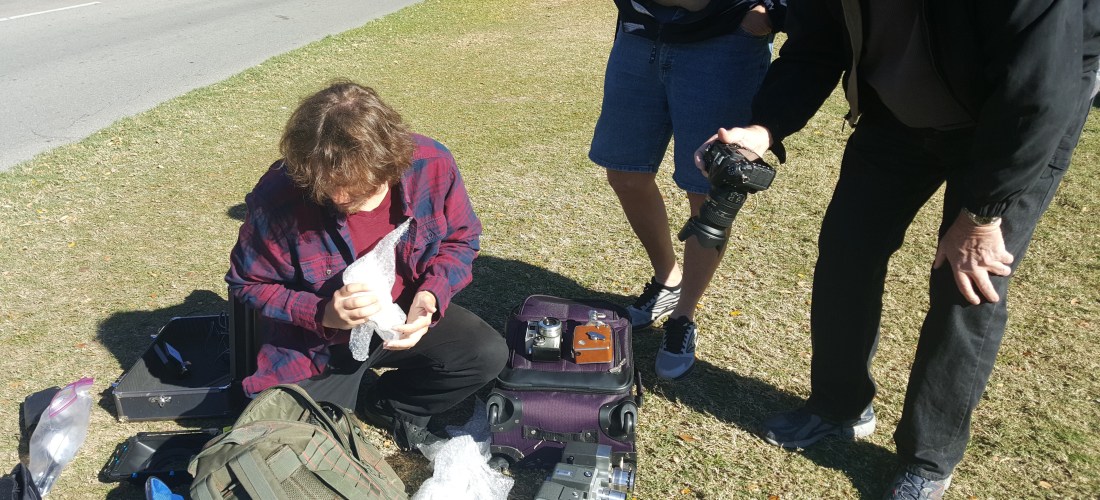
Kenneth Zediker, 23, flew in from Titusville, Fla., a week ago. He first visited Dealey Plaza five years ago when he came to visit his fiancee. On Sunday, he sat on the south end of Elm Street with about a dozen old cameras — the exact models used by assassination witnesses.

“I really hate the ludicrous conspiracy theories that put into question the authenticity of the films and photos,” Zediker said. “If you question the authenticity of the film, then we truly don’t know what occurred.”

Zediker has made it his mission — “it’s kind of an obsession” — to prove the authenticity of each photo. He plans to debunk the theories in YouTube videos using the images he re-created.

Garland resident Billy Griffith, 66, lived in Okinawa, Japan, when Kennedy was killed.

“I didn’t realize how much hate there was around here,” he said. “People hated his guts, and some were even glad it happened. I don’t think the city is over the hate yet.”

Griffith said he took the assassination hard.

“At the time he was elected, I was going along with my father, being a good Republican and thought Kennedy would make the world fall apart,” he said. “By 1963, everybody loved him and I turned completely into a Democrat. I’ve stayed one.”

Griffith often mulls over the assassination that changed his youth and has even been “a bit of a conspiracy nut,” he said.

Pablo Ortiz Jr., 61, was attending a New York Catholic school in 1963. He said what stands out in his memory happened a week after the assassination.

On a spelling test, “we had to spell words like ‘president,’ ‘congress,’ ‘government’ and ‘legislative,’” he said. “That’s when the impact of the assassination really dawned on me.”

Also on Sunday, the Sixth Floor Museum held its first event on an anniversary of the assassination. Associate Curator Stephen Fagin presented “Moments & Memories,” walking guests in the packed museum through new additions.

“This event touches people of all ages from all over the world,” Fagin said. “Dealey Plaza is a necessary pilgrimage for many people, so it makes sense to have a sampling of our newest films, photos and oral histories available.”

Fagin said the newly discovered images allow guests to see history with more context.

“You find someone in an image, try to find the images they took and talk to them about their perspective,” he said. “That’s what today was all about.”

Figures like Fort Worth Press photographer Gene Gordon made guest appearances at the event.

Gordon told museum visitors that he had stashed an 8-foot stepladder to get better photos of the president as he spoke in Fort Worth. He had snapped only one image, shown in the presentation, before a Secret Service agent told him to step down.

“I said, ‘What’s the problem? I’m not going to shoot the president,’” he recalled. “Four hours later, he was shot.”

Lewisville church displays relics of St. Charbel, patron saint of Lebanon

Uncategorized
By ADAM SCHRADER
Published in The Dallas Morning News on Nov. 29, 2015

Relics of St. Charbel, the patron saint of Lebanon, will be on display at a Lewisville church Monday and Tuesday.

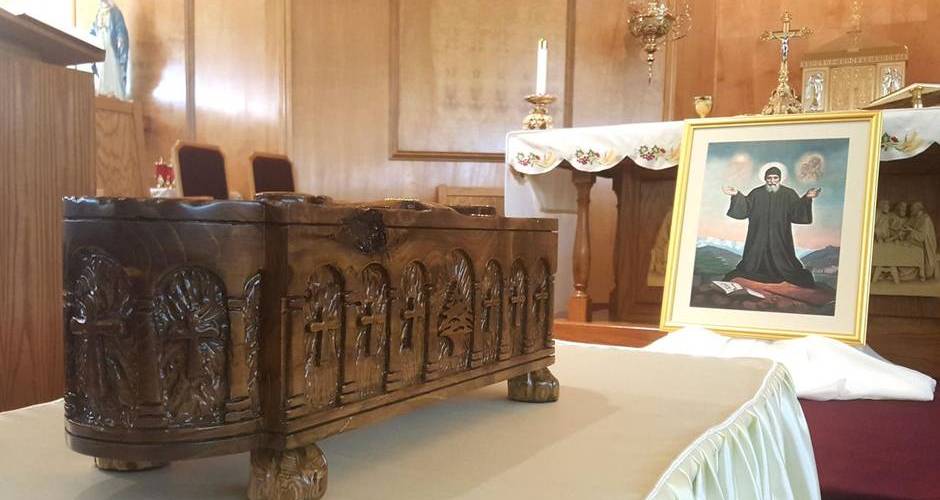
The relics, which include part of the saint’s skeleton, are visiting Maronite Catholic churches throughout the United States. All are invited to see the relics of the 19th-century monk at Our Lady of Lebanon Maronite Catholic Church, 719 University Place in Lewisville.

St. Charbel has been credited with miracles worldwide.

Parishioner Nada ElGhreichy said her brother was injured during the Lebanese civil war, which lasted from 1975 to 1990.

“He got a bullet in his head and was in a coma for two months. Doctors said if he survived, it would be as a vegetable,” ElGhreichy said. “He said Saint Charbel appeared to him seven times. Now my brother is alive, married and lives in Frisco.”

ElGhreichy said she expects people to come from across North Texas to see the relics, particularly to pray after recent terrorist attacks in Beirut.

“I have many friends that are not Maronite or Lebanese, but they pray for Lebanon,” she said. “We have some members of the church drive from Mesquite, Fort Worth and farther to attend Mass.”

ElGhreichy said she returns to Lebanon every year. It has become tradition to go visit the monastery where St. Charbel lived.

“Many people are healed through their visits and they leave there crutches there,” she said.

Youssef Antoun Makhlouf was born in Beka-Kafra, Lebanon, in 1828. He joined the Monastery of St. Maron at Annaya, Lebanon, when he was 23 and took the name Charbel. Charbel became a monk in 1853 and was ordained a priest in 1859, spending most of his religious life at the Annaya monastery. He died of a stroke during Christmas Eve Mass in 1898.

Pope Pious XI proposed Charbel’s beatification and canonization in 1925. Miracles attributed to him multiplied after his grave was opened for inspection in the canonization process in 1950. Followers from different religions started making the pilgrimage to the Annaya monastery.

Pope Paul VI canonized him in 1977. St. Charbel was the first Maronite saint formally canonized in Rome.

The Rev. Assaad ElBasha, a priest at Our Lady of Lebanon, said St. Charbel is revered worldwide among all Catholics.

Maronites, unlike churches in the Roman Catholic rite, are governed by a Roman Catholic diocese and a Maronite Catholic eparchy. The Roman Catholic diocese overseeing Our Lady of Lebanon is in Fort Worth. The eparchy, led by A. Elias Zaidan, is in St. Louis.

Our Lady of Lebanon parishioners were excited Sunday as they prepared to welcome Bishop Michael Olson of the Fort Worth diocese to their Monday night Mass.

Mattye Thompson, parish secretary of Our Lady of Lebanon, said visitors may touch rosaries to the handcarved reliquary, which would transform it into a third-degree relic of St. Charbel, meaning it touched a second-degree relic and would be considered blessed.

“It’s incredible we get the relics at the church,” she said. “I didn’t feel worthy to touch it.”

On Monday, a veneration of the relics will begin at 3 p.m., a liturgy of the hour will start at 6 p.m. and Mass will be at 7. Rosary will follow at 8 p.m. On Tuesday, there will be a rosary at 8:30 a.m., a Mass at 9 and veneration from 10 to noon.

These are the second relics to draw worshippers to a Catholic church this month. The body of St. Maria Goretti, of the Roman Catholic rite, was displayed in a glass coffin at Dallas’ St. Monica Catholic Church in early November.


“It’s incredible we get the relics at the church,” says Mattye Thompson, parish secretary of Our Lady of Lebanon Maronite Catholic Church.

Flower Mound resident runs support group for sexually abused and assaulted women

Uncategorized
By ADAM SCHRADER
Published in The Dallas Morning News on Dec. 3, 2015

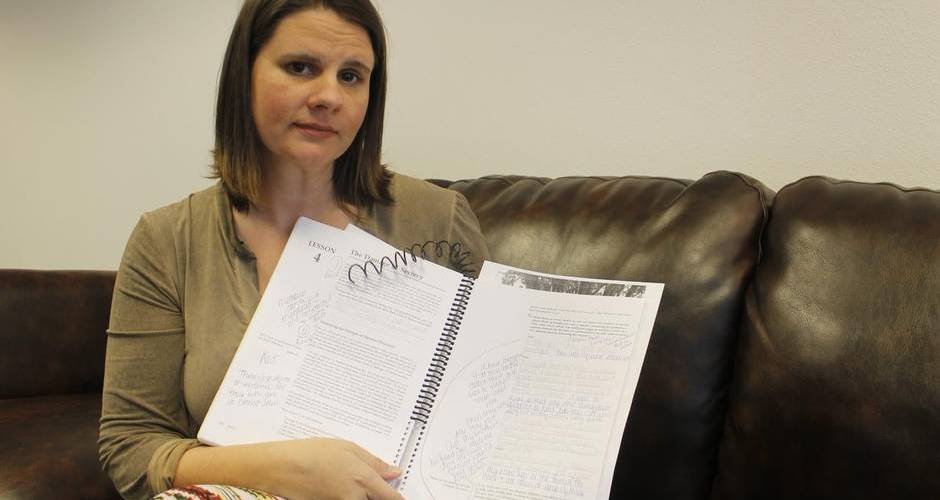
Flower Mound resident Michelle Robinson runs Shelter from the Storm, a support group for sexually abused and assaulted women. Robinson, 36, said she was abused and gang-raped as a child.

“We don’t claim this is a counseling group or to have all the answers,” Robinson said. “But giving real-life examples of how we dealt with our abuse is beneficial to women.”

The support group is affiliated with Irving Bible Church and takes its name from a Christian-based, 12-unit workbook written by Cynthia Kubetin Littlefield and James Mallory.

Kubetin Littlefield said the Shelter from the Storm support group is what she intended when she wrote the book, and that it’s designed to be worked through multiple times. She also released a DVD series to accompany it in group settings.

“I’ve seen it tremendously help women, particularly in the group settings,” she said. “I think it should be mandatory for people to be in a support group because healing won’t really come if you’re not. In support groups, you get so many different views and accounts that may help with your own.”

Robinson said that despite the workbook’s religious base she’s helped women of all faiths, as well as many women who are atheist or agnostic.

“Those women think that if God is real, he could have stopped it and didn’t,” she said. “So we don’t shove scripture down their throat.”

Robinson leads with what she wishes she had heard when she was healing from her abuse, she said.

“The facilitator’s guide is good for those ‘church answers,’ ” she said. “But when you’re dealing with hearts and people, you kind of just need to be real about it.”

Shelter from the Storm offers two-hour classes each week for 12 weeks, one for each chapter of the workbook. Shelter from the Storm usually has three groups a semester with nine women in each. Robinson meets with every woman before placement to make sure similar survivors can support each other.

The organization started in 2006 after Irving Bible Church began a recovery ministry called Celebrate Recovery.

“Survivors found that it didn’t hone in enough on sexual abuse,” Robinson said.

So Robinson met with a woman who found the curriculum, planning to lead classes based on Shelter from the Storm after they finished testing the workbook together. She’s now run the support group for eight years.

“I only do one class at a time because I’m essentially working through my own sexual abuse each time I lead the class,” she said.

Robinson selects and leads other group leaders, meeting with them to get updates on their groups. The group leaders are all women who have been through the program.

“Some support groups use counselors and spiritual leaders to run these groups,” she said. “But until you’ve been put into this situation, you really just don’t get it.”

Shelter from the Storm is also unique because classes close, Robinson said.

“We promised the ladies that nobody new will come in so we can build trust from the very beginning,” Robinson said. “If a woman is late or misses a class, we call them and check in. We love them so much we’re going to push them to be here and on time every single week.”

Robinson said it took her three years of teaching classes to feel healed. When she flips back through her workbook answers, she’s proud to see how she became more honest in her healing over time.

“So I always encourage ladies to be 100 percent honest from the get-go,” she said. “They’re only going to reach that peak of recovery faster if they’re more honest and open.”

Robinson finds that the women are always more honest and vigilant in their recovery in repeat classes.

Chapter 6, when they first share their stories, is when recovery starts to become noticeable, Robinson said.

“Many times, it’s the absolute first time they’ve ever shared their story,” Robinson said. “They break down crying immediately after they finish sharing because they feel relief and freedom.”

Chapter 7, which covers coping with anger, is almost as impactful, Robinson said.

“Survivors don’t understand that it’s healthy to still feel anger after [they] tell their story,” she said. “But they’re angry at everybody because they don’t place the blame where it belongs.”

There is an average of 293,000 sexual assault victims ages 12 and older each year, according to the Rape Abuse and Incest National Network. Someone known to the victim commits an estimated 80 percent of assaults. While it’s difficult to know how many sexual assaults actually occur, RAINN estimates that 98 percent of rapists will never spend a day in jail.

Robinson said that many try writing letters to their abusers for closure but don’t get a response. When they do, the accused only admits to part of the allegation, if at all. Most survivors resort to simulated confrontations. Robinson meets with them alone and takes on the role of their abuser.

“They get really into it and start yelling at me, I’m the [jerk] that did it and that they remember everything,” she said. “It’s a little weird, but it’s all about them just having a voice, and they always feel so much better about life afterward.”

Robinson said she frequently meets women who have been date-raped in Flower Mound. But the women rarely file police reports, she said.

Flower Mound Police Captain Wess Griffin said that sexual assault is one of the most under-reported crimes nationally. Only 36 percent of rapes are reported to police, according to the Bureau of Justice Statistics.

To date, there have been 23 sexual assaults reported this year in Flower Mound, according to the Flower Mound Police Department. Since 2005, there have been 209 reported sexual assaults in the town. The most assaults, 28, occurred in 2010. The fewest occurred in 2012 — nine assaults.

“The FMPD partners with the Children’s Advocacy Center of Denton County, Friends of the Family, SANE nurses and the Denton County District Attorney’s office to offer victims a network of social services designed to help make the victim whole again after an offense has occurred,” Griffin said. “We encourage victims to come forward and report abuse or assaults so that we can assist them as quickly as possible.”

Griffin said reporting sexual assaults quickly is crucial, but the health and well-being of the victim is most important.

“Oftentimes, victims may take days or weeks before making an outcry to a friend or family member, and this delays the delivery of critical services to the victim and may hinder the investigation of the offense,” Griffin said.

In Texas, there are no statutes of limitations for most sexual assaults and abuse, according to the Texas Code of Criminal Procedures. There is also no statute of limitations if a rape kit has been collected and subjected to DNA testing.

“But they get scared because it’s their word against the abusers and it’s hard to prove if they didn’t immediately go get a rape kit,” Robinson said. “Sometimes they ask me to go with them. They make it into the police station and walk back out before talking to the police.”

So, Robinson hopes the biggest lesson survivors learn is to tell someone about the abuse immediately.

“Keep telling people, even if it’s embarrassing, until someone believes you and takes action on your behalf,” Robinson said. “The abuser can’t continue without getting justice like they did with me.”

For more information, email shelterfromthestormibc@gmail.com.

Code violations at Irving Bazaar prompt lucha libre matches to move on

Uncategorized
By ADAM SCHRADER
Published in The Dallas Morning News on Dec. 4, 2015

For fans of the Mexican style of wrestling known as lucha libre, there’s one less venue available.

Irving Bazaar removed its wrestling ring in mid-October after a small electrical fire broke out on Sept. 30, prompting a fire code inspection.

Ricardo Cardenas, who formerly promoted the shows at the bazaar, said removing the ring was a blow to the Latino community. But he’s promoting monthly matches at Malone’s Bazaar in Dallas and looking for a new Irving venue.

For the past 18 years, Irving Bazaar has had its difficulties. The venue had been on an upswing, thanks to lucha libre matches — from local talent or renowned luchadores from Mexico like El Hijo de Dr. Wagner Jr.

“It feels bad because we’ve been there for quite a long time,” he said. “We’re getting a lot of calls from people who don’t know what to do on their Saturdays anymore. We were all so used to just going to the matches every week.”

Irving fire marshal Derek Austin said nobody was injured during the fire. But during the subsequent inspection, the department identified roughly 300 code violations, he said.

The ring had to be removed because it was an illegal use of the building, Austin said. The bazaar is classified as merchant facility to sell product. To have the wrestling matches legally, the building would require an assembly code designation.

“The building does not meet the code requirements for assembly purposes,” Austin said. “[To hold the wrestling matches], they would have to make changes and reapply and pass the assembly occupancy code inspection.”

Austin said that the department didn’t issue any fines after the inspection and the bazaar addressed immediate dangers.

“We work with the businesses in a reasonable time limit,” Austin said. “It’s not our goal to run businesses out of town and we’re still working out the minor violations.”

Brenda Soto, a spokesperson for the Bazaar, said the company working with the fire department to address the violations and make changes.

“We’re still recovering from the after effects of this fire and are trying to bring in other entertainment alternatives for our customers,” she said. “We are working on bringing back music and hosting other entertainment like mariachi’s and face painting in one of our event rooms that we plan to open to the public soon.”