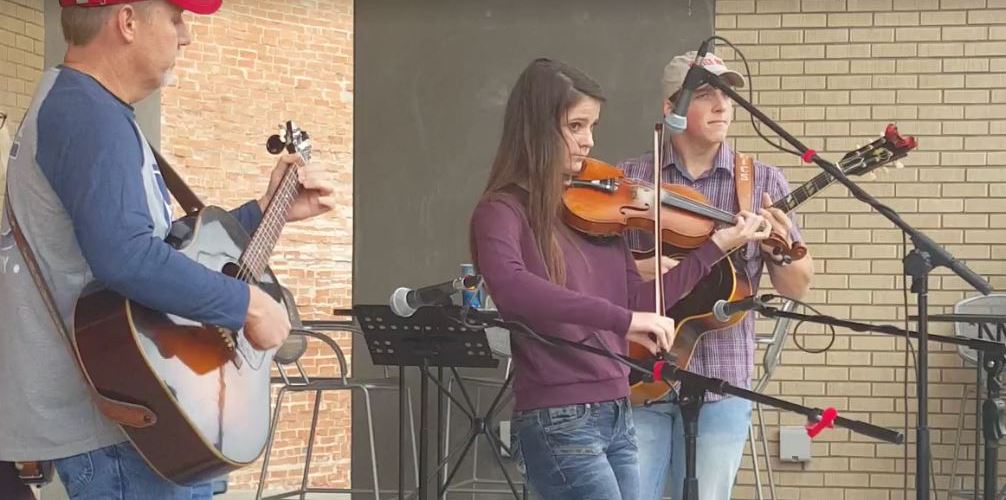
508 Park Fiddle Contest picks up long tradition

Uncategorized
By ADAM SCHRADER
Published in The Dallas Morning News on Nov. 8, 2015

More than 30 musicians competed Saturday in the first 508 Park Fiddle Contest and Concert Series.

“I can’t even guess how much money is here right now, from the old Gibson guitars of the accompanists to the fiddles themselves,” said Ed Carnes, a board member of The Texas Old Time Fiddlers Association.

TOTFA helped organize the first Dallas fiddle contest in 50 years. Bluegrass Heritage Foundation founder and president Alan Tompkins was master of ceremonies for the first of a music series put on by the Museum of Street Culture.

Carnes, who placed second in the Adult Fiddle category for ages 40 to 64, hoped the event would preserve the art of Texas fiddling.

“More than 20 years ago, there were at least 50 fiddling contests in the state and people were passionate about it,” he said. “They grew up listening to that music. When those people aged and couldn’t play anymore or passed along, some of the contests stopped happening.”

So, this competition tried to attract a younger crowd with $4,000 in cash prizes.

Brayden Baird, 8, was the only contestant in the Small Fry category for ages 8 and younger.

“I’ve been playing for a year,” he said, proudly pointing out that his favorite radio station is Bluegrass Junction. “I don’t get nervous. It’s my third time performing in a contest. I just pretend it’s me and the guitar.”

He begged for a jacket, though, the second he got offstage. The cold was the only thing that did bother him, and he wasn’t the only one.

Christianna Nugent, 12, received first in the Junior-Junior Division for ages 9 through 12. She played 49 Hats in a Rain Barrel and Lovers’ Waltz.

“I hit a few bad notes today,” she said. “If it’s too hot, my hands get sweaty and it’s hard to hit the notes. If it’s cold, my fingers get cold and it’s hard to move them.”

Her sister, Noelle Nugent, received second place in the Junior Division for ages 13 to 17. Her sisters Karissa and Faith placed third and fourth respectively in the Young Adult fiddle category, for ages 18 to 39.

Christianna said she’s happy to win, but it’s really about family and not just her biological one.

“My sisters have been in this a long time, so we’ve been to many competitions and it has definitely become like family for us here with all our friends,” she said.

Organizers introduced a category called the Roots of Western Swing to pay homage to the playing styles of Bob Wills and The Texas Playboys, The Light Crust Doughboys, Roy Newman and others who recorded at the 508 Park building. Music executive Don Law produced 843 recordings, including ones from those groups, between 1935 and 1939.

“Normally, in a fiddle contest, a soloist with two or three guitar accompanists plays classic Texas fiddle tunes,” Carnes said. “In this category, we’ll hear singing and other stuff as well that you don’t normally hear at contests.”

Leah Sawyer, 14, won first place in the new category and third in the Junior Division.

“I’m really proud I get to place and get to be up there with other players,” she said. “This is a place where I can see what other people think of my playing and how I can improve.”

Simon Stipp, 26, placed first in the accompanist category. He played for several performers.

“I think this contest is important because it’s in the heart of Dallas,” he said. “These contests are generally out in the country, so this adds some diversity to both our audience and the city of Dallas.”

Alan Govenar, the founding director of the Museum of Street Culture, planned the event. Govenar also produced Texas Style, a 1985 documentary on Texas fiddling that featured Jim Chancellor and Valerie Ryals, two of the judges on Saturday. The third judge was fiddler Wes Westmoreland.

Westmoreland said he looks for the use of micro-improvisation on the distinctive Texas fiddling tunes, where “the point of the song is still there but it doesn’t sound like anyone else’s version.”

“But, you don’t want to jazz up the song too much because you can’t lose the melody,” he said. “Then you lose the history.”

Westmoreland said live competitions preserve history better than recordings.

“Fiddle music is not a building you can go see,” he said. “It’s an art form you need to go play and see and hear.”
On 52nd anniversary, Dealey Plaza visitors reflect on JFK assassination

Uncategorized
By ADAM SCHRADER
Published in The Dallas Morning News on Nov. 22, 2015

Dealey Plaza welcomed a small crowd of conspiracy theorists and tourists Sunday, as usual. Most visitors said they were unaware it was the 52nd anniversary of President John F. Kennedy’s assassination.

But many said the assassination profoundly affected their lives.

North of Elm Street, Beverly Oliver led a group in the national anthem, and a moment of silence marked the 12:30 p.m. shooting. Oliver, a controversial figure in the assassination research community, claims to be “The Babushka Lady” featured in several photos of the incident.

Clark Phillips, 60, was one of the conspiracy theorists attending the memorial ceremony. He was in third grade the day of the assassination.

“It made an impression on me,” Phillips said. “I remember the teacher being called out into the hallway. She came back in as white as a sheet and said we had to pray.”

Denver residents Katie and Brent Goebel said they coincidentally had a Dallas trip scheduled and wanted to walk the plaza. The Goebels drew comparisons between the assassination and 9/11, the major tragedy of their youth.

“Both the Kennedy assassination and 9/11 violated the American spirit,” Katie Goebel said. “They stand starkly against the things we take pride in, like being a welcoming place of equality and protection.”

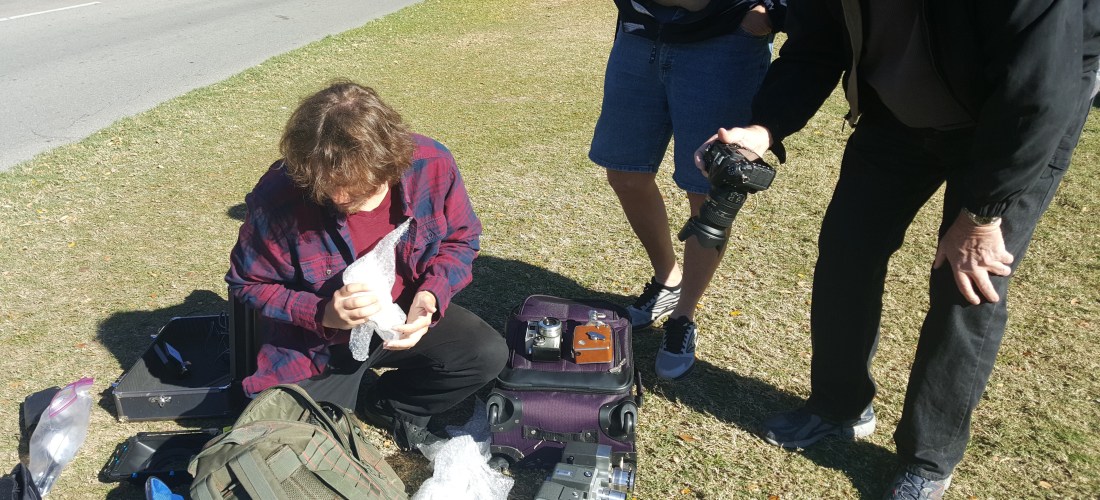
Kenneth Zediker, 23, flew in from Titusville, Fla., a week ago. He first visited Dealey Plaza five years ago when he came to visit his fiancee. On Sunday, he sat on the south end of Elm Street with about a dozen old cameras — the exact models used by assassination witnesses.

“I really hate the ludicrous conspiracy theories that put into question the authenticity of the films and photos,” Zediker said. “If you question the authenticity of the film, then we truly don’t know what occurred.”

Zediker has made it his mission — “it’s kind of an obsession” — to prove the authenticity of each photo. He plans to debunk the theories in YouTube videos using the images he re-created.

Garland resident Billy Griffith, 66, lived in Okinawa, Japan, when Kennedy was killed.

“I didn’t realize how much hate there was around here,” he said. “People hated his guts, and some were even glad it happened. I don’t think the city is over the hate yet.”

Griffith said he took the assassination hard.

“At the time he was elected, I was going along with my father, being a good Republican and thought Kennedy would make the world fall apart,” he said. “By 1963, everybody loved him and I turned completely into a Democrat. I’ve stayed one.”

Griffith often mulls over the assassination that changed his youth and has even been “a bit of a conspiracy nut,” he said.

Pablo Ortiz Jr., 61, was attending a New York Catholic school in 1963. He said what stands out in his memory happened a week after the assassination.

On a spelling test, “we had to spell words like ‘president,’ ‘congress,’ ‘government’ and ‘legislative,’” he said. “That’s when the impact of the assassination really dawned on me.”

Also on Sunday, the Sixth Floor Museum held its first event on an anniversary of the assassination. Associate Curator Stephen Fagin presented “Moments & Memories,” walking guests in the packed museum through new additions.

“This event touches people of all ages from all over the world,” Fagin said. “Dealey Plaza is a necessary pilgrimage for many people, so it makes sense to have a sampling of our newest films, photos and oral histories available.”

Fagin said the newly discovered images allow guests to see history with more context.

“You find someone in an image, try to find the images they took and talk to them about their perspective,” he said. “That’s what today was all about.”

Figures like Fort Worth Press photographer Gene Gordon made guest appearances at the event.

Gordon told museum visitors that he had stashed an 8-foot stepladder to get better photos of the president as he spoke in Fort Worth. He had snapped only one image, shown in the presentation, before a Secret Service agent told him to step down.

“I said, ‘What’s the problem? I’m not going to shoot the president,’” he recalled. “Four hours later, he was shot.”