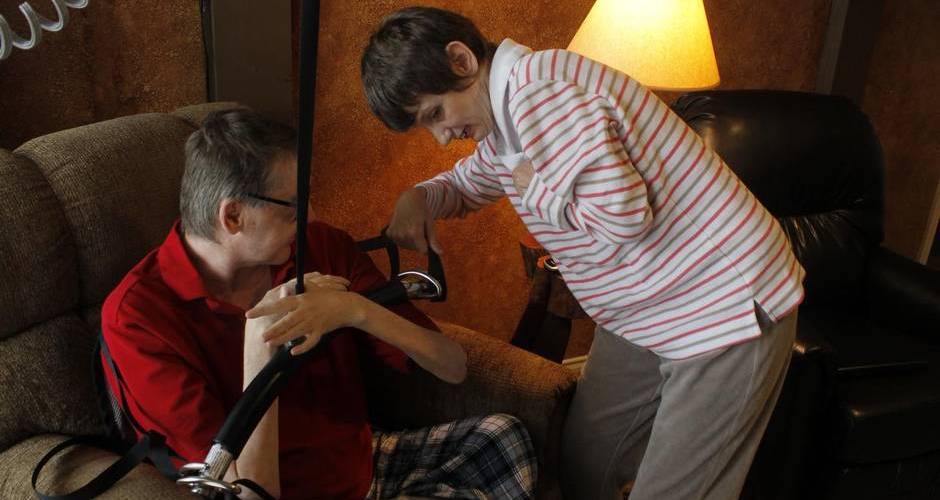
By ADAM SCHRADER
Published in The Dallas Morning News on Oct. 29, 2015
Shawn Koester and his wife, Monica, claim one functioning arm and a pair of unbalanced feet between them. But their brains are as sharp as ever.
Their diseases have made them develop logic skills greater than their able-bodied peers, Shawn said.
Shawn Koester and his wife, Monica. (Photo by Adam Schrader)
“Able-bodied people don’t realize what a process it is to put on your pants,” Shawn said. “I actually have to through a systematic process of how I’m going to brush my teeth, shower, comb my hair.”
Shawn, 50, and Monica, 42, live together without outside help as they both deal with disabilities. Monica has cerebral palsy, which comes with poor coordination, stiff and weak muscles and difficulty speaking. Shawn is a quadriplegic resulting from Charcot-Marie-Tooth Disease, which, much like muscular dystrophy, has left him without any muscle strength.
Fighting for independence comes with obstacles, they said.
“I don’t want to give up. I research ways to stay independent,” Shawn said. “It comes down to attitude and the will to make things happen.”

Shawn Koester and his wife, Monica. (Photo by Adam Schrader)(Photo by Adam Schrader)
The disease isn’t fatal, and most people with it have normal life expectancies, according to the National Institute of Neurological Disorders and Stroke.
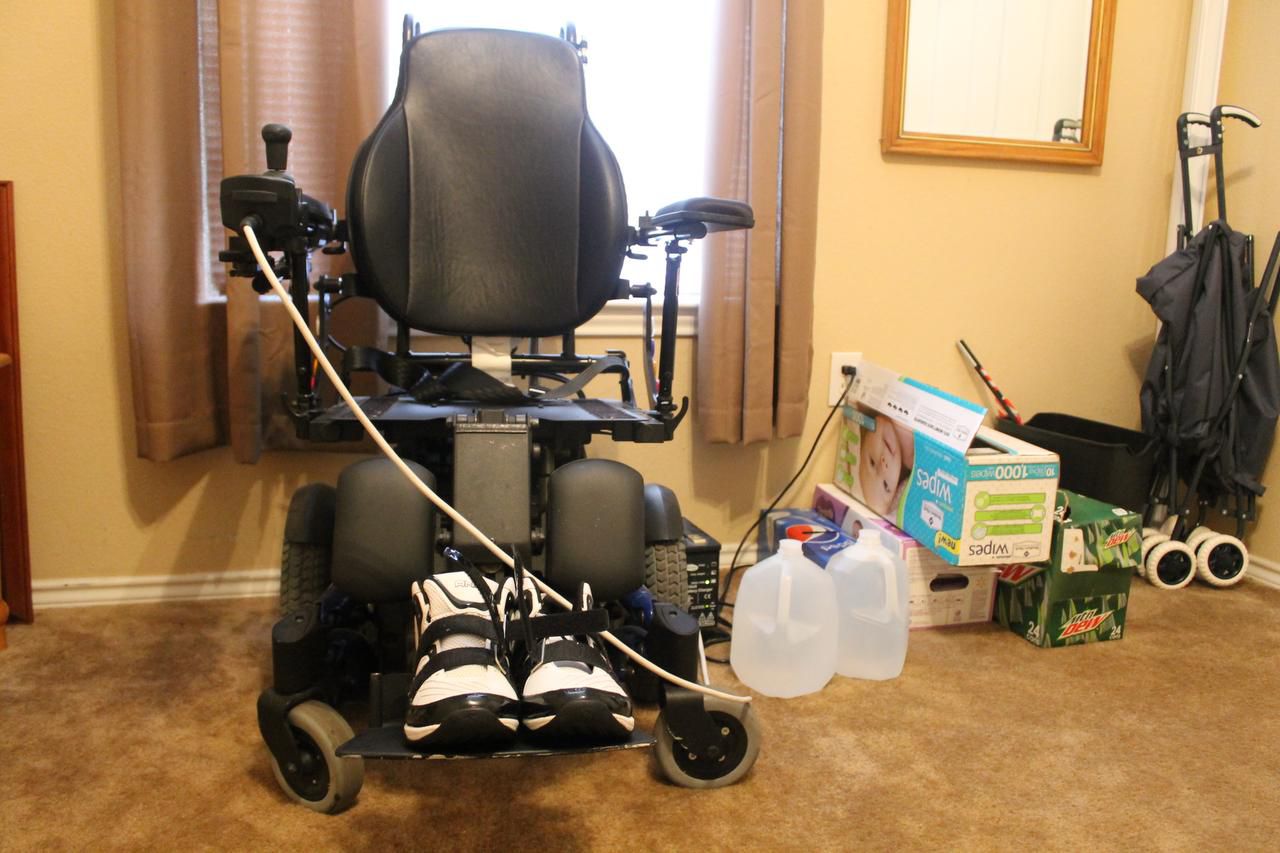
The Koesters use robotic electric wheelchairs. Their Lewisville apartment includes a motorized rail lift to carry Shawn through different rooms and lift him onto his bed and recliner. It keeps him out of the nursing home, he said.
“I have a lion inside of me, but I know that my body is disabled,” Shawn said. “I love football and run a college fantasy league online. I would love to play some football. My mind says I can do it, but my body won’t let me.”
Insurance paid for most of the lift; Shawn set up a GoFundMe campaign for the rest.
“I’m not completely paralyzed,” he said. “I can still move some, which is a blessing because I can scoot on the floor. That’s usually how I get around and use the computer.”
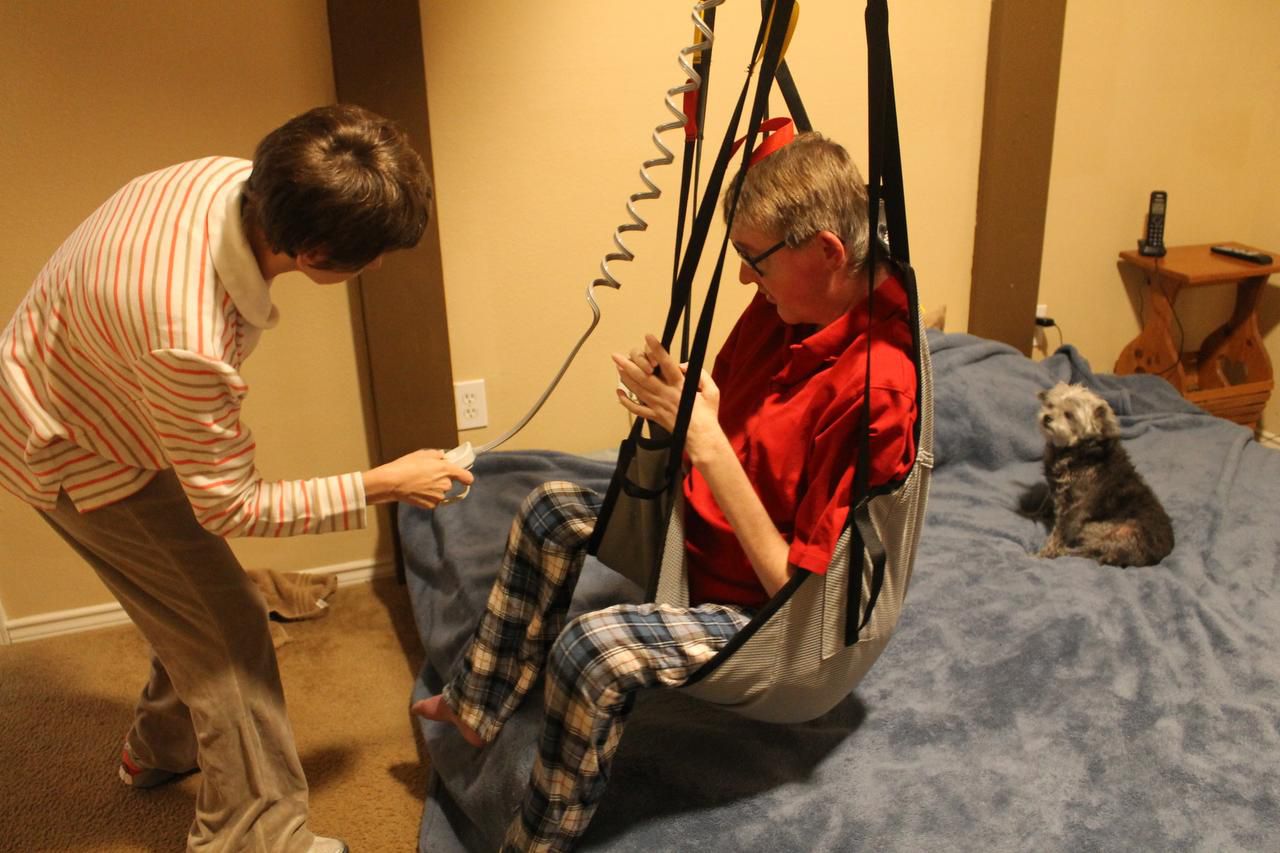
Shawn Koester and his wife, Monica. (Photo by Adam Schrader)
Monica does most of the caretaking. She cooks, cleans and takes care of their dog.
“I’m not as strong as I used to be and have issues cleaning and stuff, too,” she said. “We have to eat a lot of frozen stuff, which I know isn’t very healthy.”
In the meantime, Monica also works at Ross, a department store, across the street part-time to provide for the family.
“I like working at Ross, but it’s getting harder to do it because there are days I don’t feel very good or Shawn needs me,” she said. “But we do what we’ve got to do to stay independent.”
Monica used to ride her electric scooter to work day shifts. But now, she’s on a nightly schedule. Shawn said that a friendly co-worker drives her two to three nights a week, which has been a blessing as colder weather approaches.
“If a friend wasn’t willing to pick her up, she probably wouldn’t have a job,” he said. “We don’t really think it’s safe for her to ride her scooter across the street at night.”
Monica was raped more than 18 years ago, she said. The attack led to her now 18-year-old daughter, who also endured sexual assault as a child, Monica said. The Koesters met in an online chat room for singles soon after. Shawn helped her overcome the trauma.
More than their disabilities, Monica said, it united the couple in their fight for independence.
“Figuring out how to get the diaper on, dress Emily and being able to take care of her financially or otherwise was difficult,” Shawn said. “At one time, I was going to try to adopt Emily, but that didn’t work out. We actually missed out a lot on her growing up, which was difficult for Monica being the biological mother.”
The Koesters met Jan. 1, 1999, and were married July 2, 1999. Monica walked down the aisle. Shawn used a three-wheel electric scooter.
“My family was old-fashioned and didn’t want me to move in with him until after we got married,” Monica said. “When I was in Vegas for our honeymoon, they moved my stuff in for me.”
Monica said that unlike Shawn, she was sheltered growing up and that concerned her before the wedding.
“I didn’t know how to cook,” she said. “I was staying with my family, and they took care of the cooking and cleaning.”
Shawn walked as a child, but as he aged into adulthood, he needed support.
“Then I started falling down more frequently and had to go to a manual wheelchair that I was able to push myself,” he said. “When my muscles got weaker and I could no longer push myself, I got the electric wheelchair.”
This was around the time he married Monica — when he still had the use of his hands and could dress and wash himself.
“Sometimes when I’m trying to eat, I need help,” Shawn said. “Monica will feed me.”
Shawn said it’s been traumatic for Monica to watch his disease worsen.
“When we got married, we discussed the future and talked about how this is what we’d face,” he said. “Monica, the strong person that she is, understood that and decided to stay with me anyway.”
But Monica, too, has lost some of her ability. Her balance has worsened and her left arm, once semi-functional, is now unusable. Luckily, her speech impediment has improved some, Shawn said.
“When I met Monica, the communication between us was challenging,” he said. “Now we have no trouble with it.”
Monica says it’s because she talks more now.
The couple has lived together for 16 years — the length of their marriage. Ten years were spent in a Section 8 housing program, Shawn said. But those funds have decreased annually.
The Lewisville apartment complex formerly accepted Section 8 vouchers, Shawn said, but its new owners will not after December. The Koesters will have to start paying regular rent, which is around $950 a month.
They could try to find a new home that would take the funds, Shawn said, but a new place means costly transport and rebuilding the lift.
Shawn got his GED and attended Richland and El Centro colleges in Dallas.
“I didn’t get my degree, but I got a job in the computer lab and tutored classes,” he said. “Then I got a job as a computer operator at a bank association, which launched my IT career.”
Shawn then worked at JC Penney corporate headquarters, but his last job was at National Tech Team in Dallas before its move to Fort Worth. In all, he worked in the IT industry for 17 years.
“It was a real high honor to work for National Tech Team,” he said. “But with the baby and my increased ailments, I had to take my severance package.”
Shawn drove until 2009, when it became too difficult to transfer from his wheelchair to the driver’s seat.
“Since we don’t really go out now, we have our computer and TV and watch a lot of movies,” he said. “When we do get to go on dates, it’s awesome. It’s the little things that really give you joy and happiness.”
Now, Shawn can get stuck in the apartment for a month at a time because he doesn’t have reliable transportation. He can’t load his electric wheelchair unless a vehicle is equipped with a ramp or lift. So, he’s been researching ways purchase another van.
“God has blessed us with good brains, and I have looked into working from home,” Shawn said. “But I’ve been out of the workforce for more than a decade.”
Shawn said his IT skills are now obsolete like the technology he worked on, but updating his skills would cost money he doesn’t have.
“Reliable transportation is the only way to have any quality of life,” he said. “With a new van, I wouldn’t be able to drive — but my sister could.”
Not having to worry about paying rent would change their lives, Shawn said, and taking some of the stress off Monica having to work.
“We just want peace of mind that we can pay our rent, pay our bills and get our groceries,” he said. “Right now, we rely on those days she gets at Ross to get by. “It’s really frustrating; we don’t qualify for Medicaid and food stamps because we’re just over the limit. It just makes it tough that I can’t go out and work a full-time or part-time job to help pay the rent.”
Shawn said that living on a limited income is more difficult for people with disabilities, and living independently takes serious planning skills.
“If you needed to make some money, you can go to McDonald’s and get a part-time job,” he said. “We can’t, so we have to find other ways.”

 Adam Schrader